Digital Lending
Is that risky? Or does it work well? Well, that depends on how we do it. This article finds trending solutions for Digital Lending. Digital lending is a relatively new idea that is still establishing itself in the world of financial lending. Lenders’ initial opposition stems from concerns about security and the challenges of implementing new technologies. The short-term drawbacks of using digital platforms, such as setup costs and logistics, fool most organizations.
What is Digital Lending?
The process of giving a customer a loan using digital channels is known as “digital lending.” The entire procedure is carried out online. The entire loan application procedure, including eKYC and obtaining the customer’s credit history (CIBIL scores), is automated. It facilitates the customer journey. Every lender is attempting to increase their digital business through the use of public APIs since NPCI entered the picture with India Stack. They are attempting to impress the client with a simple and quick procedure. giving the client a personalized loan option according to their credit history.
What are the trending platforms for Digital Lending?
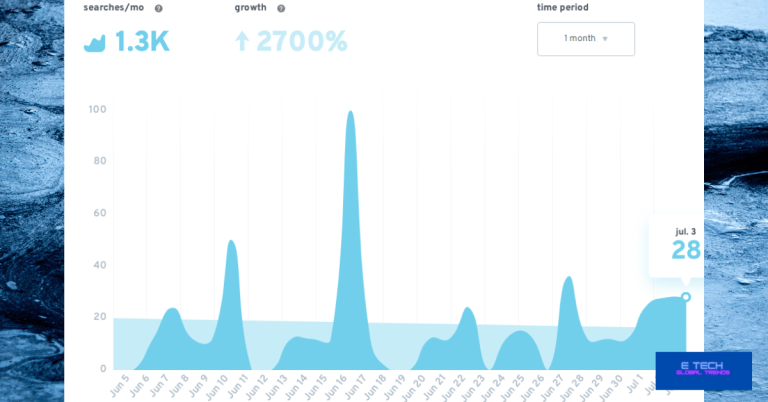
Splitero belongs to the metatrend of Accelerated Digital Lending. The current value of the digital lending sector exceeds $14 billion. It may reach $107 billion by 2033, according to estimates. This change appeals to companies that specialize in the technologies required to expedite the loan process, as well as to consumers who prioritize their mobile devices when banking.
There are solutions available in Backbase.
These are a few simplified platforms that offer fast access to capital.
Using its web platform, Figure offers residential equity lines of credit. It takes five minutes for anyone to apply, and they can get their cash in as little as 5 days. The loan amounts are from $15K to $400K. An app called Lenme instantly links lenders and borrowers. Funds are accessible within a couple of days, and loan amounts vary between $50 to $5,000. To date, Lenme has enabled 80K loans.
Auto loans with low credit ratings are offered by Lendbuzz. Via an online application, the startup instantly pre-approves debtors using artificial intelligence. Once they have a purchase agreement for a car, borrowers complete the financing through the Lendbuzz app.
How beneficial are digital lending options?
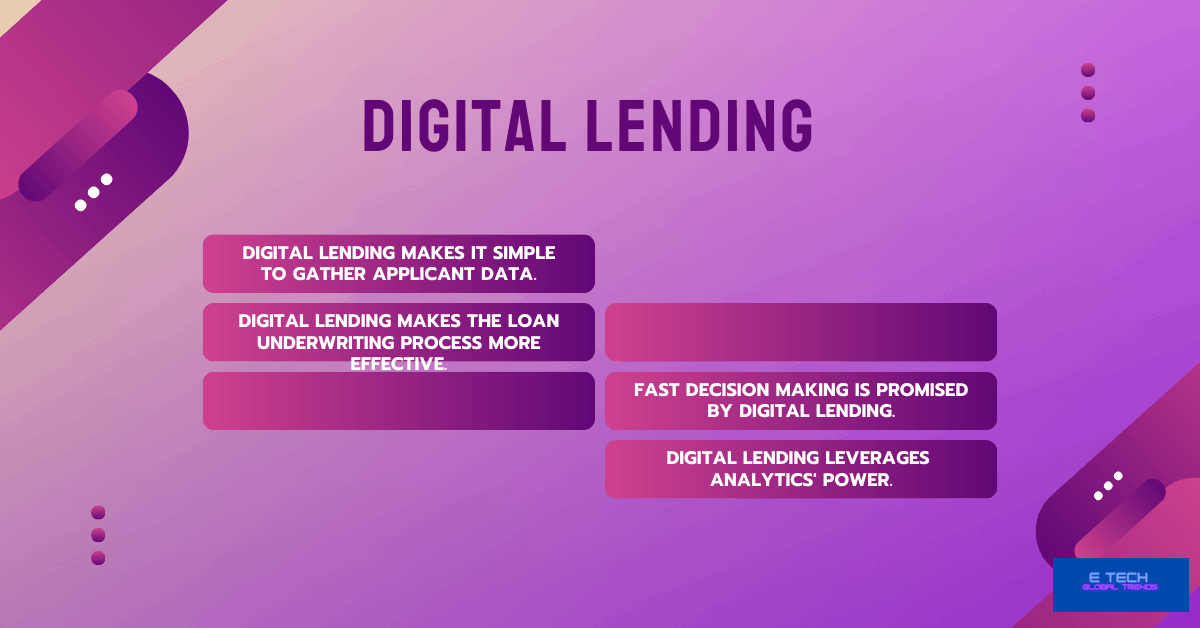
1.0 Digital Lending Makes It Simple to Gather Applicant Data.
When applying for a loan, going digital eliminates geographical restrictions. Borrowers can now immediately start a loan application from anywhere at any time, thanks to digitization. Additionally, digital lending platforms provide a highly customized user experience, expedited loan application processes, and rapid data entry.
Additionally, it reduces the possibility of human error by fixing data entries as needed. The process is faster and less complicated than it is now because even a borrower’s validation paperwork can be scanned digitally.
2.0 Digital Lending Makes the Loan Underwriting Process More Effective.
Any financial lending company looking to increase returns could benefit from some level of decision quality and underwriting efficiency. By using digital onboarding, applicants can minimize manual processes by submitting all of their information, including credentials and papers, in a digital format. The time that lenders save by interacting with clients in non-digital ways can be put to use. In spite of widespread digitization, this guarantees that customer service will always be the company’s top priority.
Data from bureaus of credit, alternative credit score data, appraisals, and risk services can all be synchronized by the system thanks to cloud integration. To ascertain whether a borrower’s loan application has an acceptable risk, decision rules are then applied to the applicant’s configured credit scores using automotive technology. The legal requirements for compliance are also supported by decision rules. These guidelines guarantee that the underwriting procedure is carried out consistently. Compared to human judgment, a combination of machine learning and AI-powered algorithms provides significantly more refined underwriting knowledge.
3.0 Fast Decision Making Is Promised by Digital Lending.
These days, instant loans are common. Nobody who is applying for a loan can wait days for their application to be accepted. Long wait times for loan examination and approval might cause a lender to lose business to a rival. That is not the kind of client or prospect that any ethical business wants to have.
4.0 Digital Lending Leverages Analytics’ Power.
In addition to creating a database of applicants, underwriting, and funding information, digital lending expedites the loan distribution process. When you combine this with the power of analytics, you end up with a far more effective lending process and better portfolio performance.
Even more intriguingly, the analytics continue to function even when the stakeholders in the organization are not present. To improve returns on investment, lending companies want more uniformity in the portfolio management and credit approval procedures. Analytics help the loan platform become more reliable by ensuring that all borrowers are evaluated equally and impartially against the same conditions and terms.
Lenders can demonstrate auto decisioning to streamline the application approval process by embracing digital automation. The era of laborious manual verifications is permanently finished. Through digitally integrating into a lending service, lenders are able to expedite the verification and decision-making process for client credentials and documents. Even loan disbursements can be completed rapidly.
5. Digital Lending Makes It Simple for Borrowers Without Credit History to Get Loans.
Credit scores are used by traditional lenders to make loan distributions. However, what happens if someone is seeking a loan for the first time and lacks sufficient collateral? Conventional lenders flatly refuse loans to customers who don’t have the creditworthiness that their successful credit repayment history can demonstrate. Even first-time borrowers have easy access to loans thanks to digital lending & its reliance on substitute credit score data. This is the reason why underbanked and unbanked people choose digital lenders.
Furthermore, removing restrictions on credit histories from the loan review process enables lenders to offer loans to a larger pool of applicants in the hopes of improving outcomes.
Is that trustworthy in a business?
Well, no internet is ever safe 100%. But the way it is established makes sense in terms of reliability. How does it help lenders? There are a few critical points that need to be considered.
1.0 Enhanced Safety
Through underwriting, users send large amounts of supporting documentation, yet paperless procedures protect the entire process. Additionally, they simplify and standardize portfolio administration, bringing much-needed order to an otherwise disorganized setting. Online portals provide safe channels of communication between borrowers and lenders. Customers and financial organizations may feel secure and at ease thanks to features like bank-level encryption.
2.0 Improve the client experience.
An automated lending system has the potential to greatly expedite and streamline the process. Candidates may apply from any location with an internet connection. Candidates are only led through the procedure, questioned for information, and assisted as necessary to make sure they enter the right information, thanks to configurable options.
Faster and More Economical Deployments.
A comprehensive overhaul of the core banking systems of many financial services firms,
such as;
- The LOS-loan origination system,
- verification processes,
- mortgage origination platform, and
- other point solutions,
is not only too costly to be feasible, but it also runs the risk of being impeded by an excessive focus on planning and rollout schedules. LaaS solutions could be a convenient and cost-effective alternative. IT teams can readily access a variety of services managed by their LaaS provider, including data communication, pricing, and pricing verification.
3.0 Using analytics to find new prospects.
With the use of analytical tools designed especially for lending, lenders can pinpoint areas that require improvement. In addition to showcasing a lender’s strengths, these tools also indicate areas that require improvement. using analytics software. This success can be replicated in other regions by identifying which ones offer the best lending prospects. To ascertain which borrower attributes influence loan performance, and to utilize this information to admit more applicants who have those attributes, and which loan terms and arrangements reduce the default risk among subprime borrowers. Additionally, identify the characteristics of borrowers that raise the likelihood of unanticipated delinquencies, and then implement more stringent qualifying requirements. Determine which tedious, unnecessary manual steps in the loan generation process can be improved by using decision rules.
Summary
A precision way to advanced tech. But handle with care.
Read more on related topics here: Enterprise tech services, Good Leap