GoodLeap
A technology business that offers software and funding for environmentally friendly solutions. GoodLeap sets itself apart by emphasizing sustainability and energy efficiency. It provides financing for solar panels, batteries, energy-efficient HVAC systems, heat pumps, roofs, windows, and other energy-efficient house renovations. Homeowners and companies looking to invest in sustainable and energy-efficient home modifications are the main target population.
Since GoodLeap was discovered on April 28, 2022, search traffic has increased by +7800% to 49.5K.
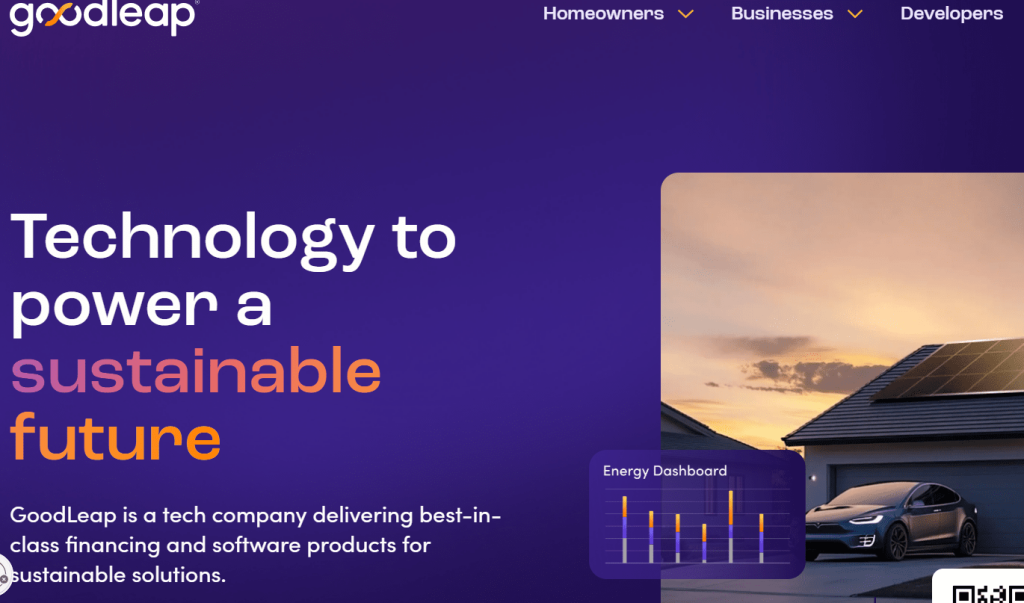
GoodLeap finances the construction of eco-friendly infrastructure for households and businesses.
They are most well-known for offering financing for solar panels. However, they also provide support for energy-efficient HVAC systems and heat pumps.
GoodLeap has sponsored systems for over 1.3 million households. The business claims to have lent $63 billion in total.
By securitizing home repair loans, GoodLeap raised $386 million this year.
Additionally, they just formed an equity arrangement to increase their solar leasing offerings by purchasing more than $1.5 billion worth of solar & storage systems.
Business Effect of Green Sustainability! How does it work?
Green sustainability’s business impact is much more than simply “doing good”; it’s a potent source of competitive advantage, profitability, and innovation. It functions by adding value to a company’s many aspects. An example is GoodLeap.
How It Operates? The Mechanism
Green sustainability incorporates social and environmental responsibilities into the main business plan. It works in a cycle…
Internal Changes and Investments:-
A business makes investments in clean technologies, sustainable sourcing, fair labor practices, and efficiency (energy, water, and waste).
Operational and Product Transformation:- As a result of these expenditures, the business’s operations and product offerings undergo noticeable changes.
Stakeholder Reaction:- These improvements are well received by consumers, investors, workers, and regulators.
Financial and Strategic Benefits:- These favorable responses result in enhanced market position and financial success, which finance more innovation.
The Principal Business Impacts (The “What”)
1.0 Operational Efficiency & Cost Reduction
How it works:- Making investments in waste reduction, water conservation, and energy efficiency (LED lighting, efficient machinery).
Direct effect:- Gradually reduces operating expenses considerably. According to circular economy models, less waste results in cheaper disposal costs and fewer material purchases.
2.0 Risk Reduction and Adaptability
How it operates:- Getting ready for climate-related disruptions, following changing environmental laws, and shifting away from limited resources.
Direct effect: Prevents fines, interruptions in the supply chain, and stranded assets. protects the company against both physical climate threats and legislative shocks, such as carbon taxes.
3.0 Growth in Revenue and Market Access.
How it operates satisfies the growing demand from consumers (of all ages, but particularly Gen Z and Millennials) for sustainable products. gaining access to markets with stringent environmental regulations and green public procurement bids (such as the EU).
Increased revenue, market share, and accessibility to new markets are direct effects. This is the foundation upon which companies like Tesla and Patagonia have built their empires.
4.0 Competitive Advantage & Innovation.
How it operates, Products, services, & business strategies must be rethought in light of sustainability problems. This promotes R&D in circular design, innovative materials, and services (such as product-as-a-service).
Direct effect:- Produces ground-breaking inventions. Examples include the whole renewable energy industry, biodegradable packaging, and plant-based meats (Beyond Meat).
5.0 Attracting and Retaining Talent
How it operates:- Employee purpose and morale are increased by a compelling environmental objective. Employees, particularly younger ones, want to work for ethical businesses, according to studies.
Direct effect:- Reduces hiring expenses, boosts output, and lowers attrition. It turns into a crucial instrument for employer branding.
6.0 Improved Capital Access and Investor Attraction.
How it operates the growth of investments in ESG (Environmental, Social, and Governance). ESG standards are currently used to manage trillions of dollars. Strong sustainability performance is viewed by investors as a stand-in for sound management and sustained viability.
Direct effects include attracting long-term institutional investors, lowering the cost of financing, and providing access to green bonds & ESG funds.
7.0 Customer loyalty and brand reputation.
What it does: Genuine and open environmental initiatives foster trust and set a company apart in a congested market.
Increased consumer loyalty, a “license to operate” from the community, and stronger brand equity are the direct results. prevents reputational disasters (in contrast, “greenwashing” undermines confidence).
The Framework for Strategy: From Burden to Core: Generally, businesses go through the following stages:
Stage 1:- Compliance: Considering sustainability as an expense to adhere to rules.
2nd Stage:- Operational Efficiency: Making use of it to reduce expenses, such as waste.
Stage 3:- Strategic Integration: Including it in the supply chain and product design to promote expansion.
4th stage:- Purpose-Driven Innovation: Putting it at the center of the market transformation and business strategy (such as the circular economy).
Examples from the Real World
1.0 Unilever:- 75% of the company’s growth came from its “Sustainable Living” brands, such as Dove and Hellmann’s, which grew 69% faster than the rest of the company.
2.0 Nespresso:- To solve a waste issue and foster consumer loyalty, the company built a sizable industry around recycling metal capsules.
3.0 IKEA:- Making significant investments in circular design and renewable energy (such as furniture buy-back programs), cutting expenses, and solidifying its sustainable brand.
(remembering our main focus. That is GoodLeap.)
Important Warnings & Difficulties
1.0 Greenwashing
Making flimsy statements without taking concrete steps backfires horribly, undermining confidence.
Short-term Costs: Long-term planning is necessary since initial investments might be substantial.
2.0Measurement
It might be difficult to calculate the return on investment for all sustainability projects; however,
9 best factors that companies take into account while putting green and sustainable data center infrastructure into place?
1.0 The term “data center sustainability” describes how environmentally friendly and energy-efficient a data center is overall.
2.0 Data centers must recycle and may reuse their equipment in addition to the standard recycling container for paper and plastic.
3.0 Reducing the quantity of needless emissions that equipment production releases into the atmosphere is the goal.
4.0 By making your firm more sustainable, you may increase revenue and improve your bottom line.
5.0 Increased revenue for sustainable firms is a result of lower operating expenses, more creative approaches, a better reputation, and a rise in new clients that appreciate sustainability.
6.0 Because they use less energy than conventional buildings, green data centers may save a lot of money. Reduced carbon footprint: Green data centers may assist businesses in lowering their carbon footprint by obtaining and effectively utilizing renewable energy.
7.0 Racks at Microsoft’s undersea data center, Project Natick, are cooled by raw seawater.
8.0 A computerized and environmentally friendly approach decreases all of the expenditures. You may also need to reduce the amount of storage you have for these things to make space for other tools and requirements.
9.0 Green data centers consist of LinkedIn’s facility in Hillsboro, Oregon, which uses a sophisticated water-side economizer that interacts with outside air sensors to take advantage of Oregon’s naturally mild environment to provide free cooling.
Compare the case with GoodLeap!
What are the financial advantages of funding sustainable development initiatives and green infrastructure in urban areas?
- Green infrastructure may lower a community’s infrastructure expenses, foster economic expansion, and generate jobs in maintenance and building.
- A variety of new educational and accreditation initiatives are developing in response to the growing need for green infrastructure expertise.
- decreasing the amount of land used and improving supply chains’ efficiency by using fewer resources to run or maintain them.
- lowering pollutants and hazardous emissions at every level of the company. Strike a balance between prospects for economic expansion and reduced environmental impact.
- Businesses cannot afford to overlook the financial advantages of being green, which include increased production, profitability, and reputation.
- Businesses may establish themselves as good corporate citizens & leaders in their sector by reducing their environmental impact.
- The value of neighboring homes rises when parks, woods, farms, stream valleys, and trees are preserved.
- Additionally, it lowers government expenditure through the natural supply of ecosystem services, raises tax revenues, boosts local businesses, lowers recreation costs, and generates jobs.
The 10 main infrastructural trends in 2026 affect sustainability and green construction techniques
Green construction techniques and sustainability are not only fads; they are radically changing the way infrastructure is planned, constructed, and run. This is how they are spearheading the change:
1.0 Carbon-Neutral and Net-Zero Objectives.
A growing number of businesses and governments are pledging to achieve net-zero emissions. As a result, infrastructure developers are being forced to:- Make use of renewable energy sources, such as solar-powered structures. Include HVAC systems that use less energy. Use passive architecture in your design to save energy.
2.0 Certifications for Green Buildings Are the New Standard
Instead of being optional, certifications such as LEED, IGBC, & WELL are increasingly becoming necessary. In order to draw investments and adhere to compliance standards, projects are now structured around these benchmarks from the very beginning.
3.0 Circular Economy and Eco-Friendly Materials
It is more common to employ fly ash bricks, low-VOC paints, recycled steel, and timber that comes from sustainable sources. Prefabrication and modular building are becoming increasingly popular, which lowers waste and improves material lifecycle management.
4.0 Intelligent Infrastructure for Energy Efficiency.
Infrastructure is incorporating IoT-enabled smart technologies to track and improve:-
Water use for lighting, the quality of the air, and the Management of waste. This lowers operating expenses while simultaneously lessening the impact on the environment.
5.0 Waste and Water Management as Fundamental Design Elements.
Rainwater collection, on-site composting units, and greywater recycling systems are being included in the design of buildings and infrastructure. From the beginning, waste treatment and segregation are integrated into community infrastructure.
6.0 Climate Resilience and Urban Greening.
Green roofs, vertical gardens, permeable pavements, and urban forestry are receiving more attention as ways to mitigate the heat island effect and enhance urban climate resilience.
7.0 Development Focused on Transit (TOD)
In order to lessen reliance on private automobiles and minimize carbon footprints, green construction techniques are being incorporated into urban design with an emphasis emphasis walkability, integrated public transportation hubs, and mixed-use complexes.
8.0 Technology for Digital Twins
Now widely used, this cutting-edge technology helps enhance sustainability results even before construction starts by simulating the performance of buildings and infrastructure. Does GoodLeap fit here?
9.0 Consumer and Investor Preference
These days, sustainable infrastructure projects are preferred by both consumers and investors. Governments and developers are being pressured by this desire to give ESG (Environmental, Social, and Governance) principles first priority when approving and funding projects.
10.0 Rewards and Rules
In addition to strengthening building code rules to enforce sustainable design & construction methods, governments are providing incentives such as tax rebates, expedited permits, and subsidies for green projects.
Conclusion
Green sustainability has a business impact by balancing profit with social and environmental well-being. GoodLeap turns possible hazards (such as climate change, regulations, and resource shortages) into chances for productivity, expansion, creativity, and fostering trust.
It is becoming more and more of a synergy rather than a trade-off in the twenty-first century. Businesses that effectively use sustainability as a primary driver of value creation will be the most durable and thrive in the future.
Look forward to the articles’ next level of experience here, Solar Energy, Digital sustainability