
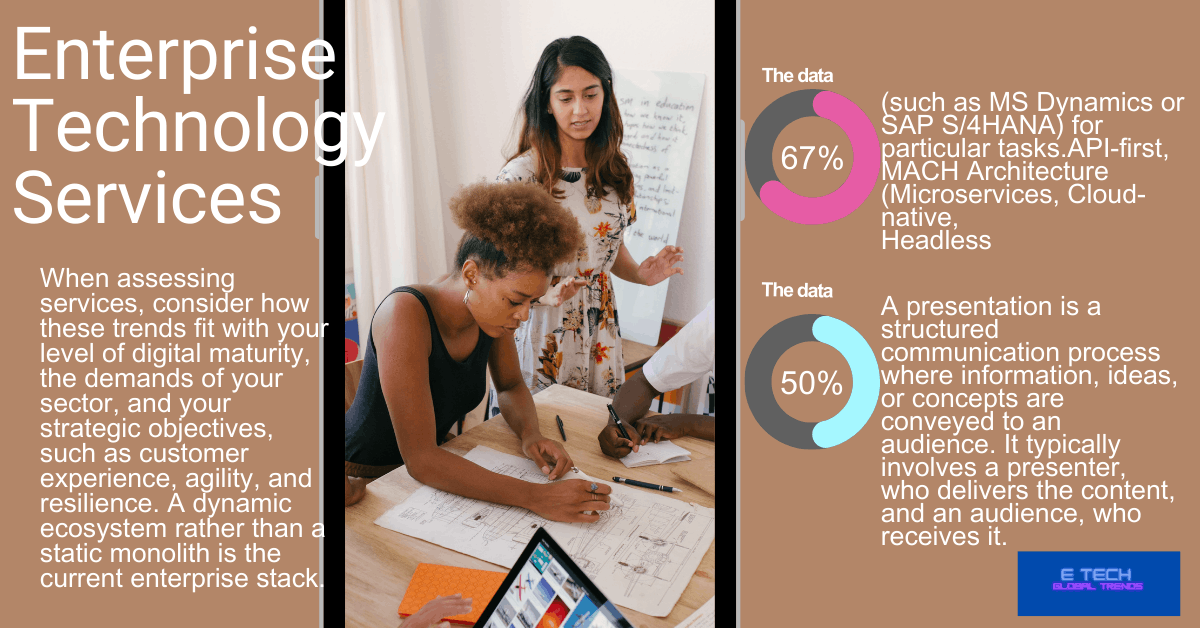
Enterprise Technology Services
The Significance of Digital Technology Services is highly trending. It is to combine the business with technology in a way make profits consistently. So, to bridge these two is critical. The transition from inflexible suites to dynamic, intelligent ecosystems is generating enormous potential for efficiency and creativity, making this an exciting period in workplace technology. This article, “Enterprise Technology Services,” is just for you. If you’re delving further into any of these areas (for example, assessing a certain trend for your company or attempting to determine which players are winning in a certain niche). Let’s get started.
A service of interconnection: why it matters?
The foundation of contemporary company operations is digital technology. Its uses are numerous and diverse, ranging from increasing customer satisfaction to productivity. The ideal partner in digital technology can:
- Encourage company expansion with innovative solutions
- Simplify procedures by integrating automation and AI.
- Assure compliance and data security.
- Use cutting-edge tools to get a competitive edge.
as a top location for services related to digital technology because
Talented Professionals:- A group of exceptionally talented engineers, designers, and developers.
Innovation Culture:- A flourishing network of well-established IT behemoths and IT startups.
Cost-effectiveness:- Excellent services at affordable prices.
Global Standards:- Hyderabadi businesses meet international standards for both quality and delivery.
Selecting the Top Provider of Digital Technology Services
When choosing a service provider, take into account:
Expertise:- Seek out a varied portfolio that exhibits technical mastery and inventiveness.
Customer feedback:- Case studies and testimonials demonstrate dependability and client contentment.
Customization:- Make sure the organization provides solutions that are specifically designed to satisfy your particular business requirements.
Post-Delivery Support:- For sustained success, regular upkeep and upgrades are essential.
Why is Layots a trustworthy partner for cybersecurity, cloud services, and IT solutions?
Businesses frequently have trouble locating a single organization that can handle all of their IT requirements when searching for a reliable technology partner. Layots Technology Services is unique in this regard.
- All-in-One IT Solutions:- Layots offers authentic software licenses and enterprise solutions in collaboration with top product companies such as Microsoft, Adobe, VMware, Oracle, as well as Red Hat.
- Cloud & Digital Transformation:- Layots guarantees seamless implementation according to company requirements, whether it’s cloud migration, multi-cloud adoption, SaaS enablement, or storage and backup.
- Networking and Cybersecurity:- Layots protects businesses using network switches (Ubiquiti, Netgear, Cisco, Extreme), firewalls (Fortinet, Sophos, F5, Juniper, Barracuda, Check Point), and inline security solutions (Harmony).
- Collaboration & Productivity:- Layots helps businesses improve team efficiency and productivity with Microsoft licenses and Zoho solutions.
- Reliable expertise:- With more than 3 years of expertise in the field, Layots has established a solid reputation by providing IT services to businesses in a variety of sectors.
From infrastructures to cloud to cybersecurity, Layots technology services may assist you along the way if you’re searching for an IT partner that is scalable, secure, and affordable.
What critical Enterprise Technology Services are highly convenient?
- Development of Web and Apps:- Applications and websites created with user-centricity, responsiveness, and scalability in mind.
- Machine Learning and AI Solutions:- utilize AI to forecast trends, customize consumer interactions, and streamline processes.
- Cloud-Based Computing:- smooth transition to cloud systems that provide cost-effectiveness and scalability.
- Solutions for Cybersecurity:- Utilize cutting-edge security procedures and monitoring systems to shield companies from online attacks.
- Analytics and Digital Marketing:- utilizing data-driven tactics to increase ROI and online presence.
- Internet of Things Solutions(IoT):- establishing interconnected ecosystems that improve user experience and operational effectiveness.
- Development of AR/VR:- cutting-edge virtual and augmented reality solutions for sectors like education, real estate, and gaming.
The Role of Naas- (Network as a Service)
NaaS is rapidly changing the landscape for businesses trying to streamline their infrastructure and increase scalability. Businesses from a variety of industries are using NaaS to simplify operations and eliminate the complexities of traditional networking, from international events to retail chains and rapidly expanding digital platforms.
Here are some examples of how Enterprise Technology Services are providing benefits in practical situations,
1.0 Global Events:-
Without overtaxing its IT staff, a significant international film festival employed NaaS to provide instant media uploads, smooth streaming, and safe digital experiences, including VIP attendees. Consistent performance was guaranteed even during periods of high traffic thanks to real-time bandwidth scaling.
2.0 Retail business:-
A major retailer that operates in both Europe and Asia brought its disparate shop networks together. The company decreased inefficiencies & freed up IT professionals to concentrate on strategic expansion rather than daily troubleshooting by using automated security and centralised control.
3.0 Tech start-up:-
Without developing a sizable internal IT department, a rapidly expanding language-learning software was able to expand internationally. NaaS offered integrated security, low-latency connections for in-the-moment instruction, and an easy-to-use method for scaling performance.
4.0 Cloud Services:-
Another cloud provider made hybrid networking easier for its business clients by utilizing NaaS. This enabled seamless performance optimization, automated updates to security, and immediate cloud access, all from a single platform.
5.0 IT Services:-
By switching to NaaS, a managed IT company greatly shortened deployment times and raised client satisfaction. Teams could concentrate on service development and innovation if they spent less time managing the network.
In all of these sectors, NaaS facilitates the automation of service delivery, the removal of manual procedures, and the development of a more flexible infrastructure, which ultimately enables companies to adjust and expand more quickly.
Now you know the background. Let’s check the selection strategy, which is crucial.
Top trending Enterprise Technology Services
Instead of the famous ones, the enterprise landscape is changing quickly with new focus areas, even though industry titans like SAP, Microsoft (Dynamics 365/Azure), and AWS continue to have a prominent position.
Today’s “trending” services focus more on specialized competencies, modernization, and strategic objectives than they do on monolithic platforms.
Beyond the well-known, well-established suites, these are the main enterprise technology services that are currently in demand.
1. IPA:- Intelligent Process Automation and Hyperautomation.
This goes beyond simple RPA by integrating low-code platforms, AI, and Process Mining to find, examine, and automate whole business processes.
Important players include Microsoft Power Platform (which is expanding quickly), Automation Anywhere, Celonis (a leader in process mining), and UiPath.
Trend: Shifting from “project automation” to “business process intelligence,” which aids businesses in determining which tasks should be automated for optimal return on investment.
2. PBCs:- Packaged Business Capabilities and Composable ERP.
Businesses are abandoning the practice of tearing down and rebuilding entire ERP systems. Rather, they employ cloud-native, best-of-breed SaaS apps that connect around a core (such as MS Dynamics or SAP S/4HANA) for particular tasks.
- API-first,
- MACH Architecture (Microservices, Cloud-native,
- Headless
are key concepts. Imagine it like a “Lego block” for business software.
Examples;
- Anaplan (connected planning),
- Salesforce (CRM),
- ServiceNow (ITSM, ESM),
- Workday (HCM), and
- Coupa (Spend management).
3. MLOps & AI Engineering Services.
Businesses are moving from experimenting with AI to implementing it in large quantities. Services related to model lifecycle management, governance, and data pipelines are needed for this.
Key Services:- AI Governance & Ethics, Vector Database implementation, MLOps platforms, and special LLM integration/fine-tuning (e.g., for document intelligence, customer service).
Important participants include cloud-native AI services.
- DataRobot,
- (GCP Vertex AI, Azure AI),
- Databricks (lakehouse for AI) and
- specialist consulting firms.
4. Zero Trust Architecture (ZTA) and Cybersecurity Mesh.
Security is shifting from a perimeter paradigm to an identity-centric, dispersed model as a result of cloud computing and hybrid work.
- CSPM:- Cloud Security Posture Management,
- SASE:- Secure Access Service Edge,
- XDR:- Extended Detection and Response, and
- IAM:- Identity & Access Management modernization
are important services.
Important participants include;
- Zscaler,
- Wiz (cloud-native security),
- Okta,
- Palo Alto Networks (Prisma SASE), and
- CrowdStrike.
5. Eco-Friendly Technology and Green IT:-
Currently, this is a board-level requirement. The services’ main goal is to quantify and lessen the digital carbon footprint.
Key Services:- integrating sustainability measurements into software development, optimizing cloud sustainability (using tools like Microsoft Cloud for Sustainability and AWS Customer Carbon Footprint Tool), and managing IT assets for circularity.
6. Platforms for Industry:-
Specific Clouds, Vertical solutions with integrated processes, data models, and compliance are being offered by hyperscalers and software providers.
Examples include Salesforce Industries (Health, Financial Services),
- Adobe Experience Cloud for particular verticals,
- Microsoft Cloud for Manufacturing & Nonprofit, and
- Google Cloud for Healthcare & Retail.
7. Platforms for Edge Computing.
Processing data at the point of generation is essential for latency and bandwidth in manufacturing, retail, and logistics.
Key services include managing distributed edge infrastructure, deploying edge AI models, integrating IoT platforms, and providing 5G-enabled edge solutions.
Important participants include Google Distributed Cloud, Azure Arc, AWS Outposts, and experts like Foghorn and Scale Computing.
8. Services for Data Fabric and Data Mesh Architecture.
These design methods are used to manage varied, decentralized data at scale rather than cramming it all into one lake.
Data Fabric:- A metadata-driven, integrated layer that facilitates smooth cross-platform data access.
Domain-oriented and decentralized, Data Mesh views “data as a product.”
Services: Talend, Informatica, and Tibco, and the hyperscalers’ tools, strategy, and execution.
9. Platforms for Unified Observability.
AI-powered solutions that offer context and speed up root-cause investigation are taking the place of conventional siloed monitoring (logs, metrics, traces).
Important participants include Cisco Full-Stack Observability, Datadog, New Relic, and Dynatrace.
10. Enterprise Blockchain (Beyond Crypto).
concentrated on particular business procedures that call for openness and confidence.
Applications include asset tokenization, digital identification, trade finance, and supply chain provenance. frequently provided as Managed Blockchain Services (like Azure Confidential Ledger and AWS Blockchain).
Key considerations: Enterprise Technology Services
Single vendor “mega-suites” are becoming less common and more common in favor of:
- Composability: Putting together nimble, superior solutions.
- Intelligence: Integrating automation and AI into all levels.
- Sustainability and security are essential, non-negotiable elements.
Vendors and consultancies now offer outcome-oriented services, including “faster clinical trials” and “increased order automation,” as opposed to merely software licenses or infrastructure.
When assessing services, consider how these trends fit with your level of digital maturity, the demands of your sector, and your strategic objectives, such as customer experience, agility, and resilience. A dynamic ecosystem rather than a static monolith is the current enterprise stack.
Summary
The top provider of services for digital technology is more than just a supplier. It is an important resource that enables companies to confidently traverse the digital terrain. Whether your company is new or well-established, using the experience guarantees that it will remain ahead of the competition.
Read more on related topics here. NaaS, Data Science for Business


Your passion for your subject matter shines through in every post. It’s clear that you genuinely care about sharing knowledge and making a positive impact on your readers. Kudos to you!
Your blog is a treasure trove of knowledge! I’m constantly amazed by the depth of your insights and the clarity of your writing. Keep up the phenomenal work!