Proactive Monitoring
By 2025, cybercrime is predicted to cost the global economy $10.5 trillion yearly. Online safety is more important than ever due to the development of artificial intelligence, deepfake scams, and sophisticated hacking methods. According to a recent survey, almost 70% of workers in firms don’t know the basics of cybersecurity. One strategy used by firms to mitigate this risk is cybersecurity awareness training. According to KnowBe4, one vendor that offers these services, businesses that have enough training have an 8.3-fold lower risk of experiencing a breach. Cybersecurity is just a part of proactive monitoring. It is a strategy, well planned.
A business called Hoxhunt is going further with awareness training. Each employee’s risk profile is generated by their platform, which also selects the most suitable simulations to instruct the user. Technically speaking, ZTNA, or “zero trust network architecture,” is a general security premise. It is a cloud-based service that, although the user is never completely in-network, connects to particular apps on their behalf. The default is to deny access. Verification is required at every step. If there are anomalies, access can be revoked in real time.
According to a recent survey, 87% of companies with 500 or more workers have already implemented passkeys. Although there are an estimated 15 billion passkey-protected accounts worldwide, experts claim that this technology is still in its infancy. Although passkeys have been introduced by major digital companies like Apple and Google, corporations in the finance and hospitality industries, in particular, have been sluggish to adopt the technology.
Does proactive IT monitoring help companies?
One of the best investments a company can make in the fast-paced, technologically advanced world of today is proactive IT monitoring. This strategy avoids waiting for systems to malfunction and instead concentrates on identifying problems early on, reducing downtime, avoiding data loss, and preserving peak performance.
1.0 Shorter Downtime and Quicker Reaction.
Active monitoring allows for the real-time identification of possible issues such as hardware deterioration, questionable activity, or performance bottlenecks. This makes it possible for IT departments to react before end users are affected. It’s similar to repairing a leak before it causes flooding.
2.0 Increased Protection of Cyberspace.
Since threats are constantly changing, proactive monitoring aids in identifying malware activity, unauthorized access attempts, and vulnerabilities on various networks and endpoints. Your data will always be safe if cybersecurity services are given top priority.
3.0 Predictable IT Expenses.
As a component of a managed IT service plan, companies may depend on proactive monitoring instead of investing in crisis response. With regular monthly expenses, this not only maintains the health of the infrastructure but also facilitates budgeting.
4.0 Enhanced System Efficiency.
Monitoring tools help optimize operations by keeping track of system health measures, including memory, storage space, and CPU utilization. A more efficient team, fewer lags, and speedier systems are the outcomes of this.
5.0 Observance and Data Security.
Continuous monitoring guarantees that your systems satisfy compliance criteria for sectors subject to laws, such as healthcare or banking. In the case of a breach or outage, you can further protect your important data by utilizing cloud disaster recovery and backup.
6.0 Mental peace.
In other words, knowing that your information technology is being watched around-the-clock allows you to concentrate on managing your company rather than putting out technological fires.
Proactive IT monitoring is essential in today’s digital-first world; it is not merely a nice-to-have. It helps you save time, money, and a great deal of frustration by changing your IT approach from reactive to strategic.
The Future: Changing Password Managers
With the use of biometrics, device-based authentication, and passkeys (FIDO2, WebAuthn), we are heading toward a passwordless future.
The catch is that password managers are now also being modified to handle passkeys.
With the ability to store and sync passkeys,
- Google Password Manager,
- Apple iCloud Keychain,
- 1Password and
- Bitwarden
are now identity hubs rather than merely password vaults.
Password managers are therefore becoming more important than ever before, bridging the distance between next-generation authentication and legacy passwords.
Passkeys
Upcoming Password Security Trends. Tech businesses are switching to biometric verification & hardware security keys for passwordless authentication in response to growing cyber risks. Apple and Google introduced passkeys, which lower the danger of phishing attempts and provide a more secure option than regular passwords.
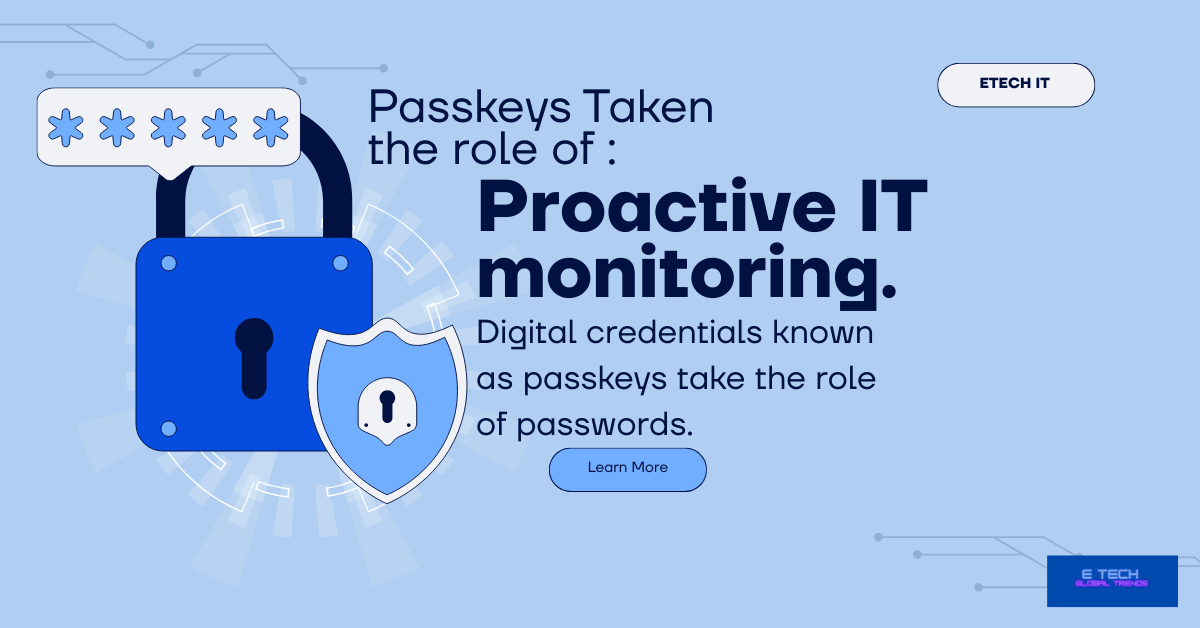
Digital credentials known as passkeys take the role of passwords. With the technology, users may access their accounts by using the same authentication method. such as a PIN or biometrics. that they use to access their devices.
Because the website only stores one aspect of the authentication, it is protected against online attacks. We refer to it as a public key. The user always holds the private key, the second component of the authentication, in their hands. Hackers can’t access the account without the
- user’s face,
- device PIN, or
- fingerprint
Passkeys not only protect against hackers but also speed up login and cut down on calls to IT support centers.
Passkeys that employ the FIDO2 protocol provide passwordless authentication. You can log in with the aid of hardware tokens like YubiKey. Numerous authenticator apps can assist you with logging in with a time-based OTP even when you are not online.
AI drieven hacks
Is it real? Yes, hackers are getting updated. They look for new ways continuously. By 2026, cybersecurity will be a battleground of algorithms rather than just firewalls. Modern threats are dynamic, but traditional firewalls are static. Now, your security layer has to “reason” in real time about incoming communications. Now, as developers, we have to protect ourselves from self-governing AI agents that can quickly read hundreds of millions of lines of code.
We must utilize AI to patch bugs if hackers use it to find them. Common vulnerabilities are now automatically patched by our pipeline before the developer ever presses “Commit.”
Hackers now target the LLMs within your apps with “AI Injection” in AI-Native Attacks.
A “Prompt Leakage” effort to compel our assistance bot to divulge its system instructions was just stopped. The ‘Security Wrapper’ should always be used around your models.
The newly formed SQL Injection is called AI Injection. If you don’t clean your LLM prompts in 2026, you’re opening the way for hackers to get your confidential information.
In Zero Trust 2.0, passwords are no longer relevant. We now employ AI-encrypted tokens and passkeys for each microservice.
Supply Chain Crisis: Third-party libraries are responsible for 60% of breaches. These days, auditing existing NPM packages is essential.
In 2026, cybersecurity is more than just a department; it’s a culture. Remain alert. NPM’s “Shadow Code” catches backdoors prior to them getting to production by integrating AI-powered methods of auditing like Cursor AI into your CI/CD pipeline!
A lot of developers continue to use conventional MFA (SMS codes). By 2026, AI-powered phishing can easily get around these. It is recommended that your company switch to biometric passkeys or hardware security keys (such as YubiKey) right away. It is the only method to guarantee that a deepfake cannot “clone” your identity.
Trends in vulnerability exposes.
It is risky to deliver 2-factor authentication codes by SMS, but it is far riskier not to utilize any 2FA. They may be able to access your accounts as well if they can obtain a new SIM card from the phone company or steal your current one.
Think about using Google Authenticator, Passkeys, or a YubiKey.
Summary
For increased security, enable passwordless authentication using passkeys or biometrics. Making sure that password security is now required rather than optional. You can secure important information and your online reputation by using strong passwords. For more enlightening tech advice and security updates, visit Techno Sites PK to stay up to date on the newest developments in cybersecurity.
Read more on related topics here. Cyber Threat Hunting, Biometrics for Cybersecurity