
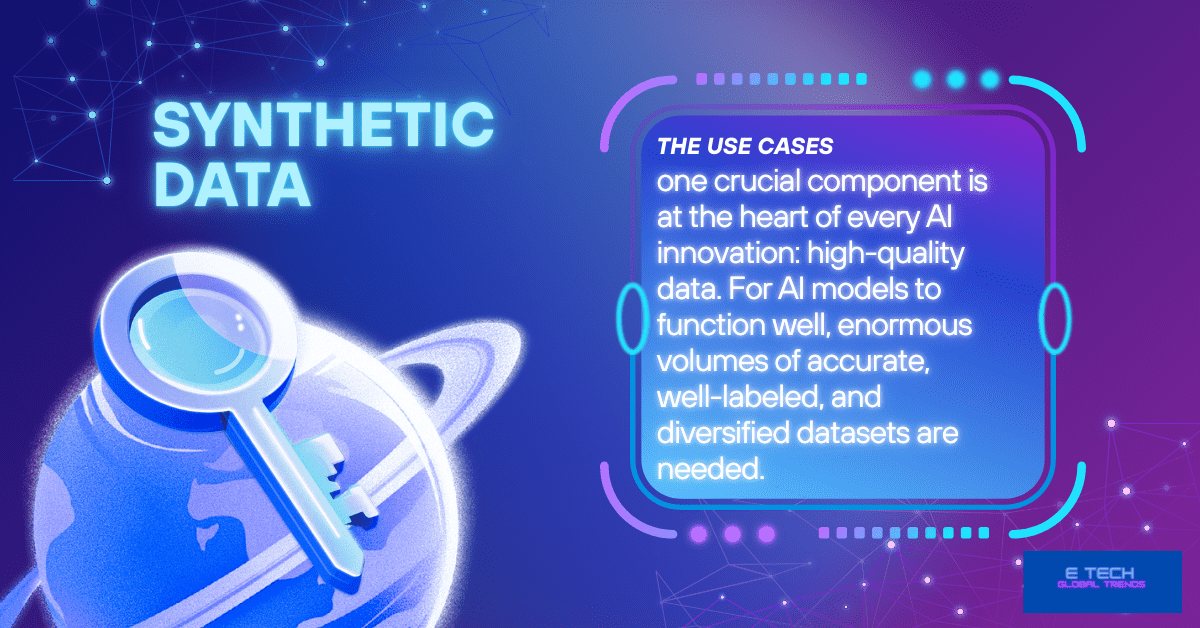
Synthetic Data
Updated on January 26. Artificially produced data that mimics real-world data by simulating its features and trends using statistical models and algorithms. It offers an affordable and scalable substitute in circumstances when actual data is hard to come by, costly to acquire, or contains private information that cannot disclose.
Particularly in industries such as healthcare, banking, and autonomous driving, synthetic data is highly valuable for research, software testing, and machine learning training.
By completing missing elements in real-world data, lowering bias, increasing data diversity, and enabling safer, more affordable training without sacrificing privacy.
AI-generated synthetic data is now capable of improving model accuracy.
AI is changing everything from cybersecurity and autonomous cars to healthcare and banking. However, one crucial component is at the heart of every AI innovation: high-quality data. For AI models to function well, enormous volumes of accurate, well-labeled, and diverse datasets are needed. However, two significant obstacles, data scarcity and privacy restrictions, are making it harder to get such data.
Real-world data is frequently scarce, expensive, or challenging to obtain. In specialized fields or infrequent situations, such as fraud detection & medical research, this difficulty is much more significant. Strict data privacy laws also make it more difficult for businesses to gather, keep, and distribute sensitive data. This limitation hinders the advancement of AI. Researchers and businesses are investigating alternatives as a result, with synthetic data being one of the most promising.
How to get into Synthetic data?
It is created artificially using AI models and algorithms, in contrast to traditional datasets that are derived from real-world interactions. It removes privacy concerns, allows for scalable data production, and maintains the statistical characteristics of real-world data.
Synthetic data is already being used by companies like Waymo, NVIDIA, and top medical researchers. They take this action to speed up AI innovation and overcome data constraints.
The influence of synthetic data will discuss in this article, along with its various forms, uses in various industries, and methods of creation.
We’ll also look at its main advantages, difficulties, and moral implications for AI development.
AI Synthetic Data: Addressing Data Scarcity & Privacy Issues
High-quality data is more important than ever as AI develops. New opportunities for AI research are being made possible by synthetic data, a potent tool created to overcome the constraints of real-world data. However, what precisely is synthetic data, and exactly how does it function? Let’s dissect it.
Synthetic Data: What is the clarification?
In essence, synthetic data is information that is created artificially to resemble the statistical characteristics of actual data. to produce, using models and algorithms, in contrast to traditional datasets that gather from real-world interactions or events. This distinction is important: synthetic data is computational, but real-world data is observational.
Synthetic data has a number of important benefits. Here are a few to mention:
Scalability:- Businesses are able to produce enormous volumes of data. This information is customized to meet their unique requirements. They avoid the time and expense limitations associated with gathering data.
Researchers can replicate uncommon occurrences with controlled variability. These are situations that are hard to find in actual data.
Privacy Concerns:- Lastly, by removing the requirement for sensitive data, synthetic data solves privacy concerns. It is a compliant option for many sectors because it doesn’t require personally identifiable information.
What are the real advantages of synthetic data?
In addition to addressing the issue of data scarcity, artificial intelligence is a strategic facilitator of AI innovation. It expedites development times, guarantees privacy compliance, and improves model performance by tackling important data problems.
Resolving Data Scarcity and Increasing Model Diversity
On-Demand Data Generation: There are frequently few real-world datasets. They may also be costly or challenging to gather. AI teams can produce high-quality, varied data that is suited to particular model requirements, thanks to datasets created by AI.
Improving Edge Cases as well as Rare Events: Underrepresented cases, such as fraud detection and medical anomalies, are frequently difficult for AI algorithms to handle. By simulating these crucial but uncommon circumstances, synthetic data improves model generalization.
Improving Fairness and Reducing Bias: it creates representative and balanced datasets. It aids in correcting class disparities. Additionally, it lessens the inherent biases in real-world data.
How to generate Synthetic data?
In order to duplicate the features of real-world data, algorithms are used to create false data. It is useful for testing systems, training models, and guaranteeing privacy protection in domains like machine learning & data analysis. For data scientists and businesses that need big datasets without jeopardizing sensitive information, this approach is especially helpful.
Clarifying simply…
There are several ways to make synthetic data. It blends statistical and AI-driven approaches. Different data kinds and levels of complexity are appropriate for each approach.
GANs- Generative Adversarial Networks:-
GANs employ two rival neural networks: a discriminator that assesses the validity of the data and a generator that generates fake data. The generated data is refined by this adversarial process until it closely resembles patterns found in the real world.
VAEs Variational Autoencoder
Real data is compressed into a latent space. They then reassemble it to provide artificial data. There are controlled variations in the generated data. This technique works especially well with structured data, such as time-series sequences and photographs.
Diffusion Models:-
Random noise is the initial state of these models. To produce extremely realistic data, they iteratively improve it. They are useful for picture and audio synthesis because of this mechanism.
Methods Based on Statistics and Rules:-
Probabilistic models and Monte Carlo simulations produce organized numerical data. They depend on pre-established distributions. This method aids in producing variants that are realistic.
Diffusion models are best for fine-grained realism, VAEs for structured data creation, and GANs for high-fidelity visual synthesis. The balance between computational cost, complexity, and quality determines the best option.
What are the Synthetic Data Types?
Synthetic data is not all the same. It can concern into 3 primary categories based on the use case:
Completely Synthetic Data:- This kind is created completely from scratch and doesn’t rely on actual data. When real data is unattainable or secrecy is of the utmost importance, it is ideal. It can be difficult to guarantee its relevance and correctness, though.
Partially Synthetic Data:- In this case, synthetic components are mixed with actual data.
For instance, in order to safeguard privacy and maintain the overall structure of a dataset, sensitive fields may be substituted with synthetic values.
Hybrid Approaches:- These techniques use synthetic and real data to strike a compromise between scalability and accuracy. Organizations can resolve class imbalance by adding synthetic samples to real datasets.
Synthetic data is turning out to be a game-changing instrument that solves the problems of data scarcity & privacy while fostering creativity.
We’ll go into more detail about these applications using examples from the actual world in the following section.
How does AI sophistication on synthetic data vary from genuine user data in the real world?
Accuracy, bias, and generalization are the practical distinctions between AI taught on this type of data and actual user data:
Computer-generated synthetic data is excellent for covering
- uncommon cases,
- scalability, and privacy.
- Although it is clear and adaptable, it might not capture the subtleties of the real world, which could result in models that are too broad or less accurate.
Because real information about users is complex, rich, and based on real behavior, AI models are more relevant and accurate. However, prejudices, privacy issues, and regulatory restrictions (like GDPR) may be present.
In reality, the finest systems frequently use both: actual data enabling grounding and realism, and synthetic data to scale / edge cases.
AI Compliance and Privacy
No PII-Personally Identifiable Information. The statistical characteristics are similar to those of real data. Sensitive user information is not disclosed. It is therefore a privacy-friendly substitute.
Smooth Compliance alongside Data Regulations:- Synthetic data helps businesses by doing away with the requirement for actual personal data. It enables them to handle intricate regulations like the CCPA, GDPR, and HIPAA. This accomplishment was there without going against the rules of compliance.
Facilitating International AI Research:- AI development is frequently hampered by international data-sharing constraints. Synthetic datasets promote privacy-first AI innovation by enabling safe cross-regional collaboration.
How do you develop and implement AI?
Faster Model Training and Prototyping:- Data collection delays are eliminated with synthetic datasets. This enables rapid prototyping and model training to be accelerated by AI teams. They enable quicker experimentation cycles while reducing dependency on costly and laborious real-world data collection by avoiding data acquisition obstacles. Because of this, researchers can more quickly and easily test, improve, and implement AI models.
Reducing Reliance on Real-World Data:-
Businesses can get around the bottlenecks in data categorization and curation by using synthetic data. They reduce the need for human annotation and expedite the creation of AI models by producing pre-labeled datasets. This method speeds up AI solution testing, iteration, and scale. It results in quicker deployment and more flexible models for practical uses.
Reducing the Cost of AI Development:-
High storage, regulatory, and legal costs are associated with real-world data. On the other hand, it offers a more affordable option. It provides equivalent or perhaps better model performance without requiring the management of sensitive data.
Addressing challenges
The Requirement of Manual Data Labeling
Pre-Labeled Synthetic Datasets:-
AI-produced synthetic data has labels already applied. This greatly lessens the need for costly human annotators. Guarantee is there for High precision and consistency.
Increasing Model Efficiency & Accuracy:-
Pre-labeled synthetic datasets increase model accuracy. They are particularly helpful in fields like structured data analysis, computer vision, and natural language processing.
Automation of AI Training Pipelines:-
Businesses can incorporate fake data into their machine learning processes. Self-sufficient AI training loops are established by this integration. Consequently, it reduces operational costs and enhances scalability.
Although synthetic data has many advantages, there are drawbacks as well. Organizations must handle ethical issues and guarantee that it is applicable in the actual world. They have to overcome a number of obstacles in order to fully realize their potential.
Let’s examine the main issues with synthetic data and how they affect the advancement of AI.
Ensuring Applicability in the Real World
Making sure synthetic data appropriately represents real-world situations is one of the biggest challenges.
Danger of Distorting Actual Distributions:-
The quality of synthetic data depends on the algorithms and models that produced it. The generated data might not correctly reflect distributions seen in the real world if the basic presumptions/generation methods are faulty. Unreliable AI models may result from this.
Model Extrapolation Problems:-
Synthetic data-trained AI models might function well in controlled settings. But when used in real-world situations, they frequently fall short.
Bias and Quality Assurance
When dealing with synthetic data, bias & quality control are important considerations.
Possibility of Biases with Data Generation:-
Datasets created by algorithms that generate synthetic data may inherit or even magnify biases.
For example, an unbalanced training dataset may cause some demographics to be overrepresented in face recognition.
Importance of Thorough Validation:-
Synthetic data must go through thorough validation along with quality control in order to reduce these hazards. To guarantee statistical fidelity, this entails comparing artificial datasets with actual data. Finding any disparities that can affect the model’s performance is another part of it.
Regulatory and Ethical Considerations
Several ethical and legal concerns are brought up by the utilization of synthetic data:
Discussions on the Ethics of AI-Generated Data:-
Concerns regarding the ethical implications of synthetic data are becoming more widespread. Is it morally acceptable, for example, to develop AI systems that affect decision-making or employ synthetic data to mimic human behavior?
Regulation of Synthetic Data in the Future:-
Synthetic data falls into a regulatory gray area, even though it helps address privacy issues. Lawmakers are still debating how to control its usage, especially in delicate sectors like finance and healthcare.
Legal Issues Concerning Ownership:-
Who owns data created by AI? Is it the AI itself, the consumers who supplied the initial data, or the corporation that developed the algorithms? These issues remain unanswered and may have serious legal ramifications. Possible solutions are…
Identifying and Stopping the Abuse of Synthetic Data
Synthetic data is capable of being used maliciously, just like any other technology:
Risks of Misinformation:- Realistic but phony datasets can be produced using synthetic data. These databases could be used as weapons to propagate false information. They may also sway public opinion. For instance, deepfakes or fake news could be produced using artificial text or images.
Adversarial AI Threats:-
Malicious actors could develop adversarial AI models designed to exploit weaknesses in systems by using fake data. Synthetic data, for example, can be used to mimic cyberattacks or get around fraud detection systems.
Issues with Explainability and Transparency
Building confidence in AI systems requires explainability and transparency. Both of the synthetic facts are getting worse.
Maintaining Transparency within Data Generation: Producing synthetic data is frequently a complicated procedure.
Because it is opaque, it is challenging to comprehend where the data was produced. AI models educated on fake data may become less trustworthy due to this lack of transparency.
Effect on Interpretability of Models:-
AI models’ interpretability may be impacted by synthetic data. It could be difficult to explain a model’s particular choice if the data fails to accurately represent real-world situations. This is particularly true in high-stakes fields like criminal justice and healthcare.
Despite the enormous potential of synthetic data, these difficulties underscore the necessity of careful thought and strong protections. To fully realize its promise and guarantee its appropriate usage in AI research, these restrictions must be addressed.
The trends: prepare for the future
Synthetic data has become a revolutionary approach to AI development, tackling two urgent issues: privacy concerns and data shortages. It has created new opportunities for innovation across businesses by making it possible to create high-quality and privacy-compliant datasets. This facilitates scenario modeling, AI model training, and quick research acceleration in a variety of industries.
In order to get beyond the limits of real-world data, many large businesses now use synthetic data. This entails correcting class disparities, modeling uncommon occurrences, and guaranteeing adherence to strict privacy laws. Simultaneously, AI-driven methods such as diffusion models, VAEs, and GANs have advanced. These developments are expanding the capabilities of synthetic data. It is now more accessible, scalable, and realistic than ever, thanks to these developments.
Technological Developments in Validation:-
The precision and dependability of synthetic data continue to be of utmost importance. For synthetic datasets to gain credibility, better validation techniques will be essential. One of these techniques is cross-referencing with actual data. They also entail the creation of uniform benchmarks.
Ethical & Regulatory Frameworks:-
The necessity for precise ethical rules will increase as synthetic data becomes more common. It is also necessary to develop regulations. Its appropriate adoption will require addressing issues with ownership, transparency, and abuse.
Integration into Next-Gen AI:-
The next wave of AI systems will heavily rely on synthetic data. This is especially true in fields like edge computing, generative AI, and reinforcement learning. It is capable of simulating a variety of situations. Additionally, it may produce tagged datasets on a large scale. These skills will spur innovation in a variety of domains, including natural language processing and robotics.
What example will make it true? (A Suggestion)
Gretel Synthetic
A platform that facilitates innovation while protecting data privacy by providing tools for creating secure, anonymised synthetic data via APIs. Gretel AI sets itself apart by offering strong data privacy tools that let programmers build artificial datasets that closely resemble real-world data without jeopardizing private data.
It is mainly intended for developers, data scientists, & companies that need to handle data securely and generate data that protects privacy for testing and development.
Gretel AI on January 5th, 2025, and as of right now, its search volume is 1.6K, growing by +2.2K%.
Why has “Synthetic Data” become so popular in marketing firms?
Because genuine data is becoming more costly and dangerous from a legal standpoint. We can’t save user data the way we used to in 2026 due to privacy rules. Synthetic Data AI-generated client personas that statistically resemble actual purchasers are increasingly being used by astute agencies to test ads.
We test a budget-heavy campaign against 10,000 “Synthetic Visitors” to forecast sentiment and click-through rate. This enables us to quickly and affordably fail in a simulation prior to investing a single dime in the actual world. Your agency is risking your money if they aren’t initially simulating campaigns.
Summary
In summary, the key component of the advancement of artificial intelligence and not merely a short-term solution to data problems. It enables businesses to test the limits of artificial intelligence. Synthetic data will remain at the forefront of technological advancement. It will influence how AI develops in the future.
Synthetic data will keep driving innovation as AI develops, influencing automation and machine learning in the future.
Take a look at related articles here: how to generate synthetic data, smart synthetic