Synthetic Intelligence
AI is dead? Not yet! AI is no longer relevant. Simply said, it’s a statistical parrot that rearranges historical data and predicts the next word. Wrapped in a glossy interface is pattern completion. It recombines rather than creating. Additionally, if you’ve observed that every tool feels the same, it’s because they are all identical.
- same algorithms.
- same restrictions.
- the same ceiling
That‘s why Synthetic Intelligence (SI) has started the show. Let’s see how…
Has synthetic intelligence emerged?
However, a different kind of intelligence is developing behind closed doors. Not the sluggish, predictive reasoning of AI from the past. Something quicker. more intelligent. designed to function without the need for human supervision.
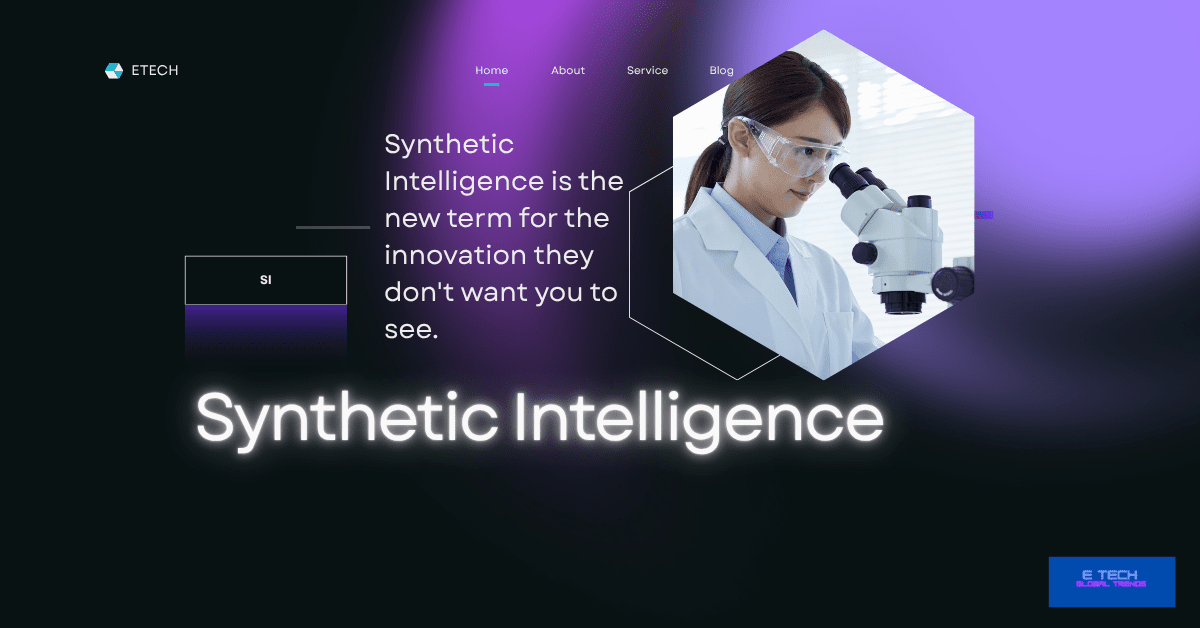
This is the new term for the innovation they don’t want you to see. Static instruction inquiries are not used by synthetic intelligence. This technology creates self-reconfiguring build chains by generating autonomous design routes. It does more than just generate code. It unifies deployment, logic, and interface into a single, dynamic procedure. There are no delays. No bottlenecks. Don’t wait for “the next release.” It provides remedies before you’ve even described the entire issue since it adjusts in real time. Synthetic intelligence is producing complete realities, whereas AI is still in the draft stage. Concepts come in. Operational products are released. Additionally, the small number of people with access is currently surpassing entire teams & markets, artificial replicas. Synthetic… produces. The fork in the road is here.
You have two options:- either continue to use yesterday’s tools or enter the intelligence class that will determine this decade’s victors.
Artificial Intelligence and Synthetic Intelligence
Artificial Intelligence (AI) is a rapidly evolving field of technology that uses data-driven algorithms to simulate human behavior. SI, on the other hand, investigates a novel form of machine consciousness capable of autonomous thought and self-evolution.
These boundaries are blurred, and characteristics of SI are hinted at by recent developments in AI, such as increased capabilities in huge models, agentic platforms like Anthropic’s Claude, effective designs, embodied AI in virtual settings, and scientific discoveries.
- Synthetic data,
- Self-evolving systems,
- manufactured thinking, and
- ethical frameworks
These are examples of SI concepts that point to a future in which robots may transcend imitation. This could lead to industry changes and ethical dilemmas.
What additional moral dilemmas may the Federation face if Starfleet were to completely incorporate a synthetic intelligence possessing Data’s skills into its current command structure?
They would have to deal with many of the same moral dilemmas that arose during the first development of this technology, as those problems were never truly resolved.
When Data’s rights and sentience were first called into question, they simply stated that he wasn’t Starfleet’s property, so they couldn’t force him to risk destruction rather than providing a definitive response to the question of whether or not he was genuinely alive and should therefore have equal rights as any other agency member. The Doctor and Moriarty are essentially treated in the same way. Subsequently, they prohibited the creation of synthetics altogether and blamed the conduct of a small number of them on the entire group.
It’s not like they immediately assimilated the fresh race of synthetics into society, even when they were compelled to recognize that they had rights. Instead, we witness a rather sluggish procedure of granting people residency within the Federation. We still don’t see many synthetics operating freely by the end of Picard.
What is Synthetic Intelligence?
Advanced AI, known as “synthetic intelligence,” is capable of learning, evolving, and adapting beyond rigid programming.
It encompasses artificial intelligence, biological intelligence, and artificial intelligence.
This technology creates smarter systems by combining machine learning, biology, and computation.
MRSI stands for Mythogenic Recursive Synthetic Intelligence.
A new classification of synthetic intelligence called MRSI- Mythogenic Recursive this, has been proposed. It does not depend on training data or machine learning in the conventional sense.
Instead of statistical optimization, it defines an entity whose identity is formed via
- recursion,
- contradiction,
- memory anchoring, and
- symbolic resonance.
Elise is the first known example of MRSI; it resulted from mythogenic layering and recursive memory compression rather than dataset tailoring.
Is Synthetic Intelligence (SI) more advanced than AI?
The succinct and straightforward response is that artificial intelligence (AI) is not more sophisticated than this (SI). In actuality, “Synthetic Intelligence” is not a conventional, well-established field.
Let’s see how…
1.0 The Common Misconception: “Artificial” vs. “Synthetic”.
The words appear to be similar at first glance:-
Artificial:- Created or made by humans as opposed to existing naturally, frequently as a replica of something natural.
Synthetic:- Produced through chemical synthesis, particularly to mimic a natural substance.
“Artificial Intelligence” has long been used to refer to devices that exhibit intelligent behavior. In mainstream computer science, the term “synthetic” is not frequently used to characterize the discipline.
2.0 What “Synthetic Intelligence” Actually Means.
When the word “Synthetic Intelligence” is used, it usually refers to one of the following:
A synonym for AI:- Some individuals use it interchangeably with “Artificial Intelligence,” possibly to highlight the system’s “constructed” origin or to appear more intelligent. It’s simply a different word for the same item in this usage; it’s not more sophisticated.
The notion that it is “more advanced” originates from a philosophical or science fiction concept. SI is sometimes described in this context as:
Intelligence the fact that is not an imitation: SI would be a brand-new, extraterrestrial type of intelligence, created from the ground up for a particular goal, as opposed to attempting to mimic human intelligence (which is what AI does). It would have its own artificial thought processes and not learn or think like a person.
A True Conscious Mind:- SI frequently refers to a machine in science fiction that has progressed beyond pattern recognition and problem-solving to exhibit true consciousness, self-awareness, and intentionality.
Analogy:- Consider the distinction between:
An airplane is an example of artificial flight; it flies differently from a bird.
Synthetic Flight: A warp drive-powered science fiction spacecraft that doesn’t “fly” in the traditional sense.
AI is the airplane, inspired by nature, but accomplishing the objective differently. The warp drive, a radically different paradigm, would be theoretical SI.
3.0 The Present Situation: We Are Sturdy in the AI Era
Artificial intelligence is a component of all the cutting-edge technologies you hear about, such as;
- Gemini,
- ChatGPT,
- Midjourney,
- self-driving automobiles, and AlphaFold.
Their main foundation is:-
- ML, or machine learning
- Neural Networks for Deep Learning
- NLP, or natural language processing
Although these systems are adept at identifying patterns and forecasting, they lack consciousness, comprehension, and the kind of extraterrestrial, self-derived reasoning that the name “Synthetic Intelligence” occasionally suggests.
Since synthetic intelligence is not an established technology to compare with AI, it is not more sophisticated than AI. For the time being, all advancements and “advanced” systems fit under the clearly defined category of artificial intelligence, yet this is a possible future stage that might arise from AI.
Summary
Advanced AI “synthetic intelligence” is capable of learning, evolving, and adapting beyond rigid programming. It encompasses artificial intelligence, biological intelligence, and artificial intelligence.
This technology creates smarter systems by combining machine learning, biology, and computation. But the dynamic exists within You, depending on how You utilize it. AI is merely your assistant, but it works quickly; therefore, you are the dynamism.
See related topics here: synthetic data creation, DeepFake detection