Compliance as a Service
Compliance as a Service: A phrase for a service that allows constant monitoring, updating, and revision of all controls in response to changes in business processes and/or regulations. CaaS offers a way to manage the headache without building an entire department from scratch. Essentially, to remain compliant after receiving a HIPAA, PCI, SOX, or other compliance assessment, you must manage the gaps, make the necessary corrections, and keep submitting proof. That phrase would be used to describe a service when you can be audited at any moment and are in compliance.
What is Compliance as a Service (CaaS)?
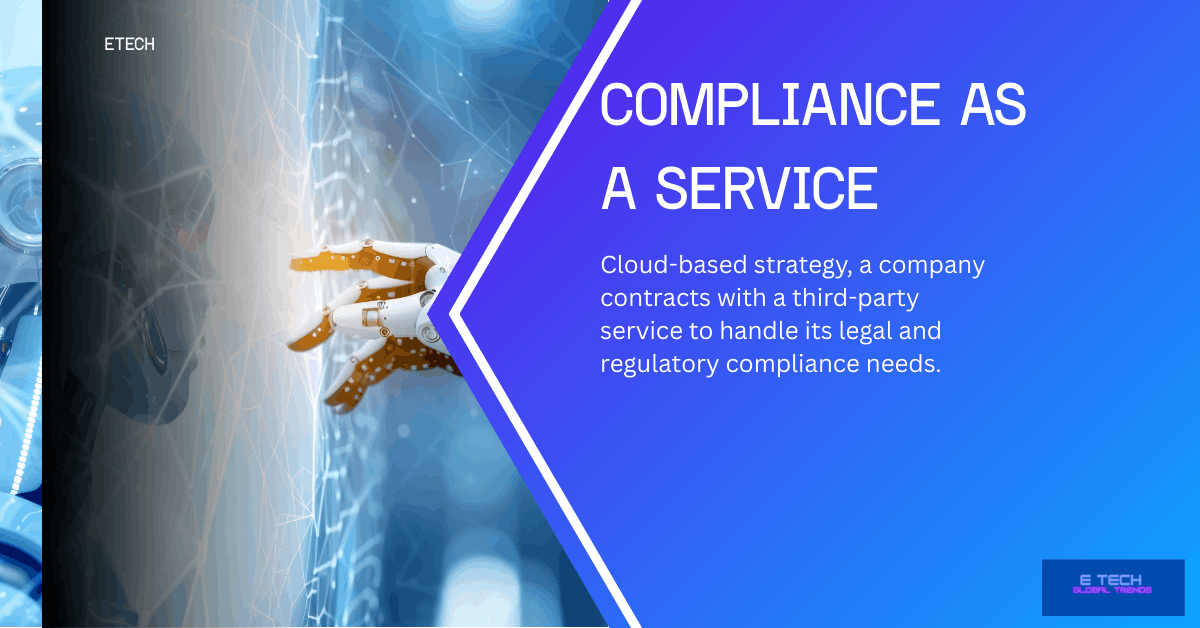
In this cloud-based strategy, a company contracts with a third-party service to handle its legal and regulatory compliance needs. Imagine employing a dedicated “security and legal” team that operates in the background to make sure you aren’t unintentionally violating any laws.
What benefits does a business offer?
Key Advantages for a Company
Cost-effectiveness:- Companies pay a subscription fee rather than investing in costly auditing tools and hiring full-time compliance officers. This turns a significant capital investment into a steady operating expense.
Access to Specialized Knowledge:- Requirements for compliance are ever-changing. Because they have access to specialists who are aware of the subtleties of international regulations that the generalist IT team could overlook, CaaS providers are immersed in these upgrades.
Automation and Real-Time Monitoring:- Conventional compliance is frequently a “snapshot” (a yearly assessment). Continuous monitoring is offered by CaaS solutions, which identify possible infractions as soon as they happen rather than months after.
Risk Mitigation:- CaaS dramatically reduces the danger of data breaches and the ensuing hefty fines (and reputational harm) by automating data encryption, access controls, and reporting.
Scalability:- The CaaS provider may swiftly activate the required frameworks (such as GDPR) to guarantee the company stays compliant in the new region if it grows into a new nation (for example, by relocating from the US to the EU). Look at the chart below.
| Feature | In-House Compliance | Compliance as a Service (CaaS) |
| Cost | High (Salaries + Software) | Lower (Subscription-based) |
| Updates | Manual tracking of laws | Automated/Vendor-managed |
| Deployment | Slow (Recruitment/Setup) | Fast (Plug-and-play) |
| Monitoring | Periodic (Audits) | Continuous (Real-time) |
Drata provides a platform for automated security and compliance.
The cloud-based platform offers solutions for more than 20 compliance frameworks, including GDPR, SOC 2, and HIPAA.
More than 300 native apps can be connected to the Drata platform by users, allowing for automatic monitoring and evidence gathering.
To automatically identify and resolve compliance concerns, Drata, for instance, has “compliance as code” capabilities that interface with GitHub in addition to tools.
According to the startup, the compliance procedure is 12 times faster due to their automated technologies.
Drata attracted 2,500 new clients in the most recent fiscal year, increasing its overall clientele to over 7,000.
The business declared in February of last year that its ARR had reached $100 million. Over 85% of worldwide corporate executives believe that over the past three years, compliance standards have gotten more complicated.
The time-consuming and error-prone nature of manual tracking and monitoring techniques makes them a nightmare.
According to nearly 60% of businesses, coordination is essential to their compliance models.
Additionally, automation can further simplify compliance processes with new AI technologies.
Because of this, some startups are offering solutions that integrate compliance throughout the whole corporate ecosystem and automate processes.
What makes compliance crucial for businesses?
Accounting is necessary for all business operations to run smoothly because it keeps track of all business transactions, including income and expenses, to ensure statutory compliance. This helps investors and management make the best business decisions, along with planning their strategies based on quantitative financial information. Maintaining clear and current financial records is essential to the survival of your company. Let’s examine why accounting is essential to every business:
1.0 Guarantees corporate compliance.
Businesses are guaranteed to comply with the law when they use a regulated accounting system. A suitable accounting system will provide comprehensive and sound management of a firm’s finances because different states have distinct laws and regulations. It will guarantee accurate handling of all.
- obligations,
- accounting-related, including GST,
- income,
- Profit,
- loss,
- tax,
- pension funds, etc.
2.0 Assessment of corporate performance
Your company’s financial records, which are gathered from a variety of business activities, show the state and health of your company’s finances. Keeping track of
- business spending,
- profit and loss,
- investments,
- margins, and potential debt
is made easier with well-organized and transparent records. In order to deploy the budget appropriately, it also examined the financial records of the current and prior years.
3.0 Calculating liquidity.
An effective accounting system aids in assessing a company’s liquidity position, which is defined as the amount of cash, along with additional resources, that can be used to meet significant financial obligations. By identifying financial bottlenecks, it simplifies cash management and lowers the danger of bankruptcy.
4.0 Handling legal obligations
To provide timely reports to a variety of
- stakeholders, including tax authorities,
- directors,
- regulators,
- shareholders, and
- investors,
It is legally required to keep accurate financial records of business activities. Additionally, they are necessary for filing taxes.
How can companies streamline compliance with Axipro’s Drata SOC 2?
You are aware of how difficult and time-consuming a SOC 2 audit can be if you have ever attempted to complete one on your own. It can be overwhelming to gather evidence, monitor security measures, and ensure that everything is audit-ready, especially for startups and expanding companies. Drata SOC 2 from Axipro is a game-changer in this situation.
Drata is an automatic compliance tool that keeps an eye on your security measures and prepares you for SOC 2. technology and human guidance. When you combine Axipro’s experience with Drata’s automation.
Axipro’s Drata SOC 2 eliminates the need for enterprises to manually search for evidence or concern about overlooking compliance holes. Axipro assists with proper Drata setup, connects it to your business procedures, and helps you prepare for the audit. They essentially eliminate all of the journey’s complexity.
Why is it important?
Because SOC 2 compliance is about demonstrating to your customers that you truly handle data security seriously, not just about undergoing an audit. It’s frequently a deal-breaker for SaaS companies, financial organizations, or any company handling sensitive data. With Drata SOC 2 from Axipro, you can accomplish compliance more quickly, cut down on human error, and concentrate on expanding your company rather than becoming bogged down in paperwork.
Summary
The Reasons Behind Businesses’ Transition: “The cost of compliance is high, but the cost of non-compliance is often terminal.” Keeping up with the “alphabet soup” of regulations—ISO, PCI-DSS, GDPR, and CCPA—can impede innovation for startups and mid-sized businesses. Because the provider takes care of the “defensive” aspect of the business, CaaS eliminates that friction, freeing up the leadership team to concentrate on product development and expansion.
Read more on related topics here.IaaS, Micro SaaS