
Business and data science
Data is a precious and vital asset for any business. Data processing, analysis, & visualization are among the responsibilities of data science. Professionals in business and data science are responsible for effectively managing, analyzing, and interpreting large volumes of data to understand market trends and identify patterns.
In order to derive valuable insights from data, data science integrates programming, statistics, and domain knowledge. To assist companies and organizations in making wise decisions, it entails gathering, cleaning, evaluating, and modeling data. Data science is essential for resolving complicated issues and spurring innovation in a variety of sectors, including healthcare, banking, and retail.
What is Data Science?
Data science is the study of data to derive valuable insights for applications in business and other fields. The procedure is this. It includes several duties,
such as;
Data Collection:- Compiling unprocessed information from multiple sources.
Cleaning, modifying, and getting data ready for analysis is known as data preparation. Data analysis is the process of identifying patterns and trends by using statistical approaches and other techniques.
Data Visualization:- Producing visual depictions of data to enhance comprehension and convey results.
Model Development:- Predictive models are frequently created using machine learning methods.
Communication:- Outlining and sharing the gleaned insights to help guide choices.
The objective is to comprehend data. It uncovers hidden patterns and converts data into insights that may use to inform decisions.
Machine learning:- what is it? What is the difference between ML & data science?
- A subfield of AI called machine learning is concerned with creating algorithms t
- That lets computers learn from data,
- anticipate outcomes, and get better over time without needing to be explicitly programmed for every task.
How does it operate?
Large datasets are used to train algorithms to find patterns, which they then apply to new data to generate predictions or classifications.
Data Science Role:- In a data science toolbox, machine learning is a crucial instrument for automating procedures, generating predictions based on data, and deriving meaning on a broad scale.
Why data science?
It’s Everywhere. Even When You Don’t Notice It, and that’s just what you can observe. Behind the scenes, it’s managing supply chains, enhancing electricity networks, and even customizing healthcare.
Without the progress in data science, we would still be living in the past:
- no smart assistants,
- no fraud detection in financial services,
- no AI-enhanced creativity in art and music.
Picture a scenario where your favorite applications couldn’t suggest content, where industries depended on intuition rather than predictive analytics, or where medical research took years instead of months.
The reason for this is that data science is truly dominating various fields at the moment, and its influence is only expected to grow.
Top data science benefits for business purposes.
1.0 Informed Decision-Making.
Data science empowers organizations to enhance their decision-making processes by relying on data analysis instead of gut feelings. By examining trends and patterns, businesses are able to uncover opportunities and reduce risks.
2.0 Predictive Analytics.
Utilizing methods such as machine learning and statistical modeling, data science equips businesses to forecast future outcomes. This is essential for areas like sales predictions, understanding customer behavior, and assessing risks.
3.0 Innovation.
Data science drives innovation by revealing new insights and opportunities, which can result in the creation of new products, services, or business models informed by data analysis.
4.0 Competitive Advantage.
Organizations that successfully utilize data science can achieve a notable competitive edge. By responding more swiftly to market dynamics and customer preferences.
5.0 Interdisciplinary Applications.
Data science is relevant across various sectors, including healthcare, finance, marketing, and social sciences, making it a flexible approach for addressing complex challenges in different areas.
6.0 Big Data Management.
In light of the rapid increase in data volume, data science equips professionals with the tools and techniques necessary to manage and analyze extensive datasets, turning raw information into valuable insights.
7.0 Efficiency and Optimization.
Data science assists organizations in streamlining their operations by pinpointing inefficiencies and recommending enhancements. This can result in cost reductions and improved productivity.
8.0 Personalization.
In industries such as marketing and e-commerce, data science is employed to study customer behavior and preferences, facilitating tailored experiences that can boost customer satisfaction and loyalty.
To summarize, data science is essential for leveraging data to support strategic objectives, enhance operational efficiency, and drive innovation across various industries.
Why is data science crucial for a Business?
Data analysts and data scientists can be seen as interchangeable roles, with the primary distinction being their areas of focus and methodologies.
Data analysts generally concentrate on applications within the business realm. They often come from a corporate environment but possess strong skills in advanced mathematics and statistical analysis, which they may have acquired during their education or through their professional experiences.
On the other hand, data scientists are usually tasked with developing, fine-tuning, and overseeing intricate algorithms that are based on business data.
What is the trending role of data science in line with business?
Naturally. Given how much data science has evolved and how closely it is now woven into fundamental business strategy, this is a great question.
Data science’s role as a specialized, technical activity that generates intriguing insights is no longer the norm. Its development as a key, strategic partner that generates quantifiable corporate value through data-driven decision-making at all levels is the prevailing trend.
6 important changes in accordance with corporate goals;
1. Proactive and Prescriptive Analytics Replace Reactive Reporting.
Trend: Using descriptive analytics to create reports and dashboards that detail prior events.
Presently, sophisticated models are being used to forecast future events (predictive analytics) and, more crucially, to suggest actions to take in response to them (prescriptive analytics).
By doing this, the position of “data historian” is replaced with “strategic advisor.” Not only is it saying “sales are lower 10%,” for instance, but it’s also forecasting “which customers are most inclined to churn next quarter” and recommending “here is the ideal discount that you can provide each one to retain them.”
2. Promoting Automation and Operational Efficiency.
Trend: Using analysis to pinpoint inefficient regions.
Presently: Developing systems that manage and optimize corporate operations autonomously with little assistance from humans.
The bottom line is directly impacted by business alignment.
Is this really working? Yes, here is how…
Supply Chain:– Real-time delivery route optimization to reduce time and fuel consumption.
Manufacturing:– Predictive maintenance reduces downtime by employing computer vision over the manufacturing line to identify machine issues before they occur.
HR:- Automating the preliminary resume screening process to find the most qualified applicants.
3.0 Large-Scale Hyper-Personalization
Trend: Dividing clients into general categories (e.g., “men aged 21-35”).
Presently, machine learning is being used to comprehend the preferences and actions of each consumer in order to provide them with experiences that are unique to them.
One of the most important competitive differentiators in marketing, e-commerce, & entertainment is business alignment. It raises lifetime value, retention, and customer acquisition.
Examples include Amazon’s product recommendations, Spotify’s Discover Weekly, Netflix’s recommendation engine, and customized marketing emails.
4.0 Data Democratization and the Emergence of the “Citizen Data Scientist”
In the past, data scientists guarded sophisticated data and tools. Users in business have to ask for reports.
Data scientists are currently developing strong data pipelines and self-service analytics platforms (like Tableau, Power BI, and Looker) to enable managers and business analysts to examine data and discover solutions on their own.
Business alignment greatly accelerates the decision-making process. Domain specialists can use data in everyday tasks, and data scientists can focus on more strategic, complicated problems.
Data Democratization and the Emergence of the “Citizen Data Scientist”
In the past, data scientists guarded sophisticated data and tools. Users in business have to ask for reports.
Data scientists are currently developing strong data pipelines and self-service analytics platforms (like Tableau, Power BI, and Looker) to enable managers and business analysts to examine data and discover solutions on their own.
Business alignment greatly accelerates the decision-making process. Domain specialists can use data in everyday tasks. And data scientists can focus on more strategic, complicated problems.
5. Calculating Risk and Using It to Guide Strategy
The process of risk analysis was then frequently qualitative or merely quantitative.
Presently: Developing advanced models to measure operational, market, and financial risk. directing long-term strategy through scenario analysis and simulation.
Business alignment: This gives leaders a better grasp of the possible benefits and drawbacks when they make decisions worth billions of dollars. This is essential in the fields of banking ( credit scoring and fraud detection), insurance (premium pricing), and market expansion.
6. AI as a Product: Integrating AI/ML with the Product.
Then: Applying data science to internal business improvement.
Trend: The product or a key component of the product is the result of data science.
Business Alignment:- This results in completely new sources of income and company plans.
Examples include FinTech apps that offer automated investing advice (robo-advisors), Grammarly’s writing helper, and Tesla’s Autopilot.
The Skillset That Changes (The “Unicorn” Changes)
Technical skill is not enough for this new role. The contemporary data scientist needs to be both a business strategist and a translator.
- Technical Proficiency (The Foundation):
- Cloud Computing (AWS, GCP, Azure), Python/R, SQL, Statistics, and
- Machine Learning.
Business acumen, or “The Differentiator,” is a thorough comprehension of the market, KPIs- key performance indicators, factors that influence profitability, and the competitive environment.
Communication and Storytelling:- The capacity to convince non-technical stakeholders to act by elucidating complex outcomes. A crucial component of this is data visualization.
Product Sense:- Knowing how a model will work in a product that users will interact with and how it will affect the user experience.
Conclusion
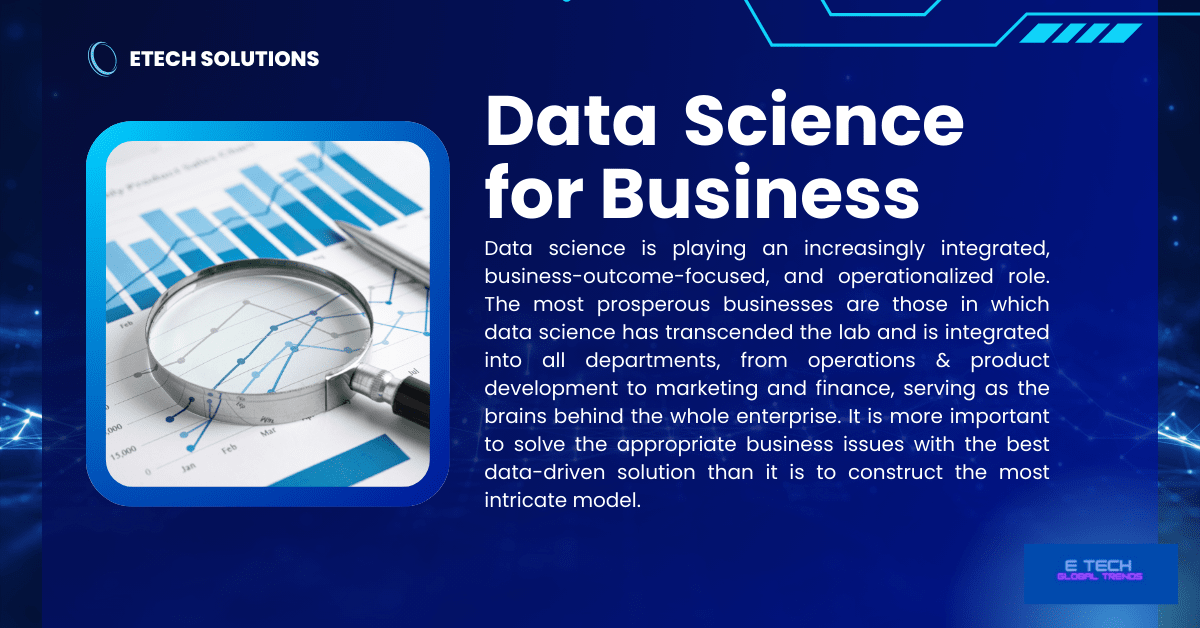
Data science is playing an increasingly integrated, business-outcome-focused, and operationalized role. The most prosperous businesses are those in which data science has transcended the lab and is integrated into all departments, from operations & product development to marketing and finance. serving as the brains behind the whole enterprise.
It is more important to solve the appropriate business issues with the best data-driven solution than it is to construct the most intricate model.
Hope this content helps. Read more on related topics here. Data Storytelling